
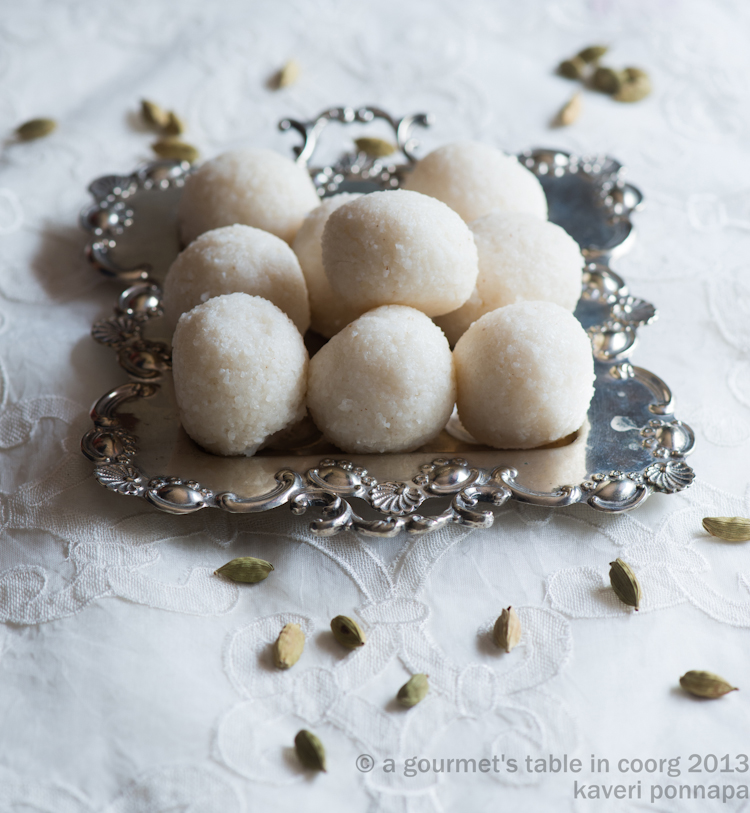
Kadambuttus are an old-fashioned favourite – plump, steamed rice puttus, faintly glossy on the outside, firm and moist in texture. They are cooked piled up neatly, and swathed in damp muslin in a traditional steamer. They are a personal favourite, equally good with the classic pandi curry, or with a simple curry of vegetables and dal. At breakfast, they can be eaten with fresh butter or ghee, and a selection of homemade jams, or honey
Ingredients:
- 2 cups tari or idly rava
- 4 cups water
- a pinch of salt
- about 3-4 tsp melted ghee
Method:
- Keep a traditional steamer (sakala) or a pressure cooker, covered with a lid, water simmering below a separator, ready to take the kadambuttus. There should be a gap of about 4 inches between the simmering water and the vessel that holds the puttus. If you are using a pressure cooker, do not use the weight.
- Bring 4 cups water to a boil in a medium sized vessel.
- Drop in a tablespoonful of tari, and a pinch of salt.
- Stir with a wooden spoon, lower the heat to a simmer, adding the tari in large tablespoonfuls, allowing it to cook before adding the next batch. This is an almost continuous process, as the small batches of tari will cook quickly.
- Stir firmly until the water is absorbed, and the tari is cooked, but still moist and soft, not dried out.
- Cover the vessel, and allow it to cool for a minute or two.
- Apply some of the melted ghee to the palms of your hands, scoop up slightly larger than lemon sized portions of the hot, cooked tari.
- Roll it into smooth, compact balls between the palms, exerting a slight pressure.
- If using a pressure cooker, line a stainless steel vessel with a fine, damp muslin cloth, and stack the kadambuttus carefully, cover loosely with muslin cloth, place the vessel on the separator. There should be a gap of about 4 inches between the water and the vessel that contains the puttus.
- Steam on a full flame (without the weight) for 15 – 20 minutes.
(2 cups of tari should give you approximately 15 kadambuttus, depending on the size that you roll out)
Tari is rice, which is washed, dried and hand-pounded so that each grain is broken into roughly three pieces. Idly rava or rice rava, is an easily available, reasonably good substitute. See note on ingredients.
Thank you for visiting this page. If you read something that you enjoy, or see an image that you like, please take a moment to write a response. Do look out for the recipes of all the food featured here in my upcoming cookbook.

We tried the kadambuttu recipe and it turned out wonderful!!! The coorg style mushroom curry is one of the favourites at home. Waiting for more of your vegetarian recipes..
Welcome to The Coorg Table! Thank you very much for sharing your favourites – there are already a few vegetarian recipes posted that are really delicious. Do try them out – the kumbala (pumpkin) curry is really excellent, and so is the bainay (brinjal) fry, which has a sour-sweet flavour. There are several other vegetarian recipes coming up soon, so do look out for them. Warm wishes.Kaveri.
Will definitely try this! What a feast with gojju 🙂
Hi Ranjani, do let me know how it turns out. Kadambuttus are traditionally paired with Pandi Curry. But they taste equally delicious with Coorg honey and fresh, home made butter, jam and also with a good, earthy vegetable curry. You can try out any of these combinations. As children,it was a real treat to eat kadambuttus with home made ghee and sugar at breakfast! Enjoy! Kaveri